

SEM vs SEO: Key Differences & Benefits
Discover the essential differences between SEM and SEO. Learn how search engine marketing can complement search engine optimization strategies to enhance your online visibility and drive traffic effectively.
sridigital solutions
12/30/20254 min read
Introduction
In the constantly changing realm of digital marketing, it is essential to understand the differences between Search Engine Marketing (SEM) and Search Engine Optimization (SEO) for organizations looking to establish a strong online presence. Although these terms are often used synonymously,
What is SEM?
Search Engine Marketing (SEM) is a comprehensive digital advertising strategy that involves promoting websites to increase their visibility on search engine results pages through paid advertising. SEM includes various paid search methods, with Pay-Per-Click (PPC) advertising being the most well-known technique. When you encounter sponsored listings at the top of Google search results, you are witnessing SEM in action.
With SEM, businesses can bid on specific keywords that potential customers might use when searching for products or services. When someone searches for those keywords, the advertiser’s advertisement prominently appears in the search results. The advertiser only incurs costs when someone clicks on their ad, making it a cost-efficient way to draw targeted traffic to websites.
The main platforms for SEM include Google Ads (previously known as Google AdWords), Bing Ads, and other search engine advertising platforms.
What is SEO?
Search Engine Optimization (SEO) is the practice of enhancing your website to rank higher in organic (non-paid) search engine results. Unlike SEM, SEO aims to gain visibility through relevance and authority rather than through financial compensation. SEO entails a mixture of on-page optimization, off-page tactics, and technical improvements to make your website more appealing to search engines.
SEO comprises several crucial elements. On-page SEO focuses on refining individual web pages with relevant keywords, quality content, meta tags, headers, and internal links. Off-page SEO is centered on establishing authority through backlinks from credible websites, social signals, and brand mentions. Technical SEO ensures search engines can effectively crawl and index your website by addressing aspects like site speed, mobile responsiveness, XML sitemaps, and structured data.
The objective of SEO is to enhance your website’s organic rankings for relevant searches, thereby boosting visibility and driving qualified traffic without the need to pay for every click.
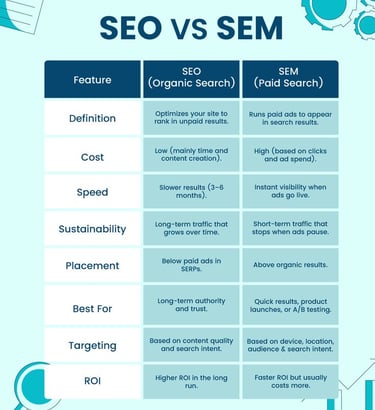
Cost Structure: One of the most evident differences is the cost structure. While SEO is technically free regarding placement, it demands investment in content creation, technical optimization, and possibly professional services. SEM, on the other hand, necessitates direct payment for ad placement, usually following a pay-per-click model, where you pay every time someone clicks your advertisement.
Time to Results: SEO is a long-term strategy that can require several months to yield significant outcomes. Building authority and ascending search rankings necessitates patience and steady effort. Conversely, SEM can provide instant results. Once your campaign is approved and activated, your ads can begin appearing in search results within hours.
Visibility and Positioning: SEM ads commonly show up at the top of search results pages, identified as sponsored content. This prime placement provides excellent visibility but clearly marks the content as paid advertising. SEO outcomes are found in the organic section beneath the ads, and while they might not always be at the top, users tend to trust organic results more than paid advertisements.
Sustainability: SEO offers sustainable, long-term benefits. Once you achieve favorable rankings, you can uphold them with ongoing optimization and high-quality content. SEM results cease immediately when you stop paying for ads. Your visibility is directly connected to your marketing and budget.
Click-Through Rates: Research indicates that organic search results frequently achieve higher click-through rates than paid ads, as many users prefer selecting non-sponsored results. However, ads do attract clicks from users with immediate purchase intent.
Testing and Flexibility: SEM provides greater flexibility for testing various messages, offers, and targeting strategies. You can change ad copy, modify bids, and experiment with different methods quickly. Changes in SEO require longer to implement and evaluate, as search engines need time to recrawl and reassess your pages.
Benefits of SEM
SEM provides multiple advantages for businesses seeking prompt visibility and measurable outcomes. The immediate exposure offered by SEM allows your business to appear at the top of search results as soon as your campaign is launched, making it perfect for new websites, product introductions, or time-sensitive promotions.
The precision targeting features of SEM enable you to connect with specific audiences based on detailed criteria such as location, demographics, interests, and search behavior. This ensures your advertisements reach the most relevant potential customers. The measurable return on investment (ROI) in SEM is another key advantage, as advertising platforms deliver thorough analytics illustrating exactly how your budget is performing, including impressions, clicks, conversions, and cost per acquisition.
SEM also enhances brand visibility even when users do not click on your ads. Being at the top of search results boosts brand recognition and builds credibility. The comprehensive budget control offered by SEM allows you to establish daily and campaign budgets, pause campaigns whenever desired, and adjust spending based on performance.
Benefits of SEO
SEO provides considerable long-lasting value and credibility for businesses willing to invest time and effort. The cost-effectiveness of SEO is substantial because, while it requires initial investment, organic rankings do not incur click costs, making it more economical over time. High-quality SEO traffic typically converts better than paid traffic since users tend to trust organic outcomes, and the traffic is highly targeted based on search intent.
SEO builds sustainable, long-term results that continue to provide value long after the initial optimization efforts. Good rankings can endure for months or years with proper maintenance.
Conclusion
Both SEM and SEO are potent digital marketing strategies that fulfill different roles and timelines. SEM provides instant visibility and precise targeting through paid advertisements, which makes it suitable for rapid results and specific campaigns. SEO fosters sustainable, long-term growth through organic search rankings, cultivating authority and trust over time.
The most effective digital marketing strategy often incorporates both SEM and SEO. SEM can generate immediate traffic while you develop your SEO groundwork, and SEO delivers cost-effective long-term visibility as your paid campaigns keep targeting specific opportunities. By understanding the strengths and constraints of each method, you can devise a holistic search marketing strategy that maximizes your online presence and generates substantial business results.
Phone
challagundlasrinivasarao77@gmail.com
+91-8317635506
© 2025. All rights reserved.
Disclaimer
Sri Digital Solutions provides digital marketing services to support business growth. We do not guarantee specific results as they may vary based on industry, competition, and marketing budget.
Privacy Policy
We collect personal information (name, phone number, email) only to deliver our services and communicate with clients.
We do not sell or share your data with any third party except for required service integrations like analytics and ads.
Terms & Conditions
By using our website or services, you agree to follow our service guidelines, payment terms, communication policies, and confidentiality requirements.